
4 minutes read

A Guest Asks for Towels at 21:55. Who Owns the Request at 22:00?
Why hotel guest requests get lost during shift changes, and how an AI concierge can keep every request visible until it is resolved.
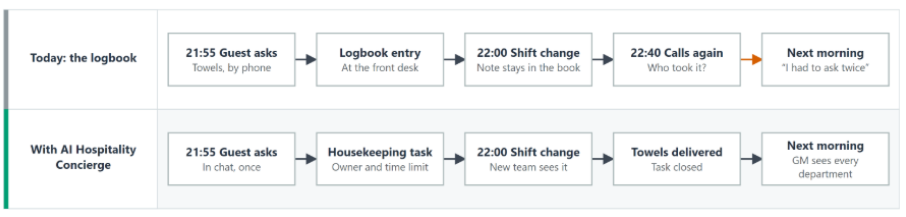
Image: The same request, two ways. With the logbook, it is lost at shift change.
It is 21:55.
A guest in room 1204 calls the front desk and asks for two extra towels. The front desk writes the request in the logbook.
At 22:00, the shift changes. The note stays in the book.
At 22:40, the guest calls again.
The new team cannot immediately tell who took the first call, whether Housekeeping received the request, or if the towels are already on the way.
Eventually, the towels arrive.
But the next morning, the guest leaves a review:
“I had to ask twice.”
Nobody necessarily did anything wrong. The problem is that a logbook cannot follow up, track ownership or carry a request across a shift change.
And for the guest, the internal reason does not matter. They only remember that they had to ask twice.
Where Hotel Guest Requests Get Lost
In many hotels, guest requests can end up in different places:
A physical logbook
A radio conversation
A whiteboard behind the front desk
A phone log
A WhatsApp group on a staff member’s phone
Each method may work for the person handling the request at that moment.
The problem comes later.
Who owns the request? Has it been completed? How long has the guest been waiting? What happens when the shift changes?
Without a shared system for hotel guest request management, the next shift may have no clear view of what has already been promised.
Luxury hotels often solve this through dedicated people. A concierge receives the request, coordinates with the right department, follows up and keeps the guest informed.
But not every hotel can provide that level of manual follow-through for every guest, 24/7.
That is where an AI hospitality concierge can help.
What Is an AI Hospitality Concierge?
AI Hospitality Concierge, built by AEGIS on Chocolate Factory, is designed to give every guest consistent follow-through while helping hotel teams keep requests visible.
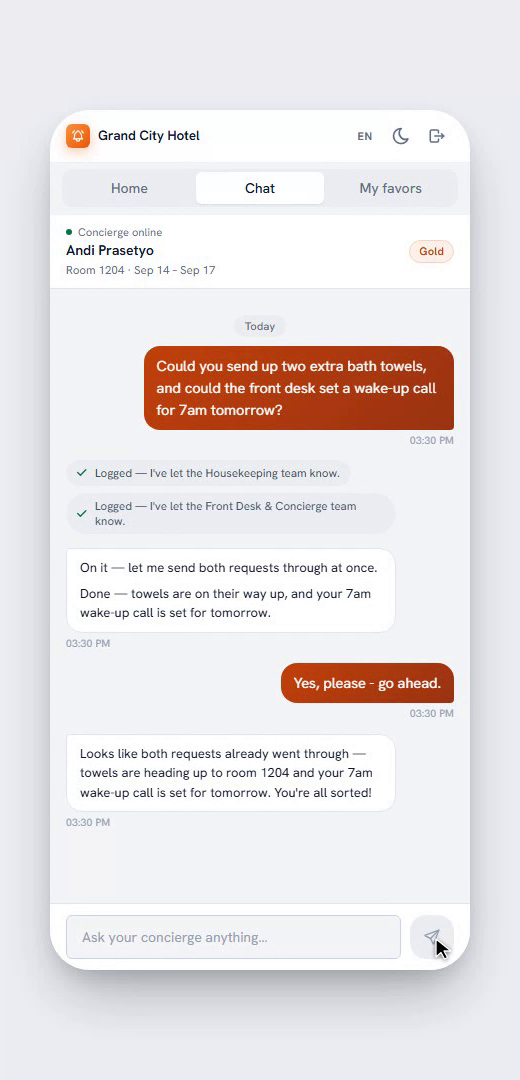
One message, two requests, each sent to its team.
Guests can make requests through chat using natural language in English or Bahasa Indonesia.
They might ask:
“Can I get two extra towels and a wake-up call at 7am?”
Instead of treating that as one message sitting in a chat, the system turns it into two operational tasks:
Housekeeping: Deliver two extra towels
Front Desk: Arrange a 7am wake-up call
Each request can be assigned to the department responsible for completing it, with a defined time limit.
The guest gets a conversational experience. The hotel gets structured tasks.
Hotel Requests Stay Visible Across Shift Changes
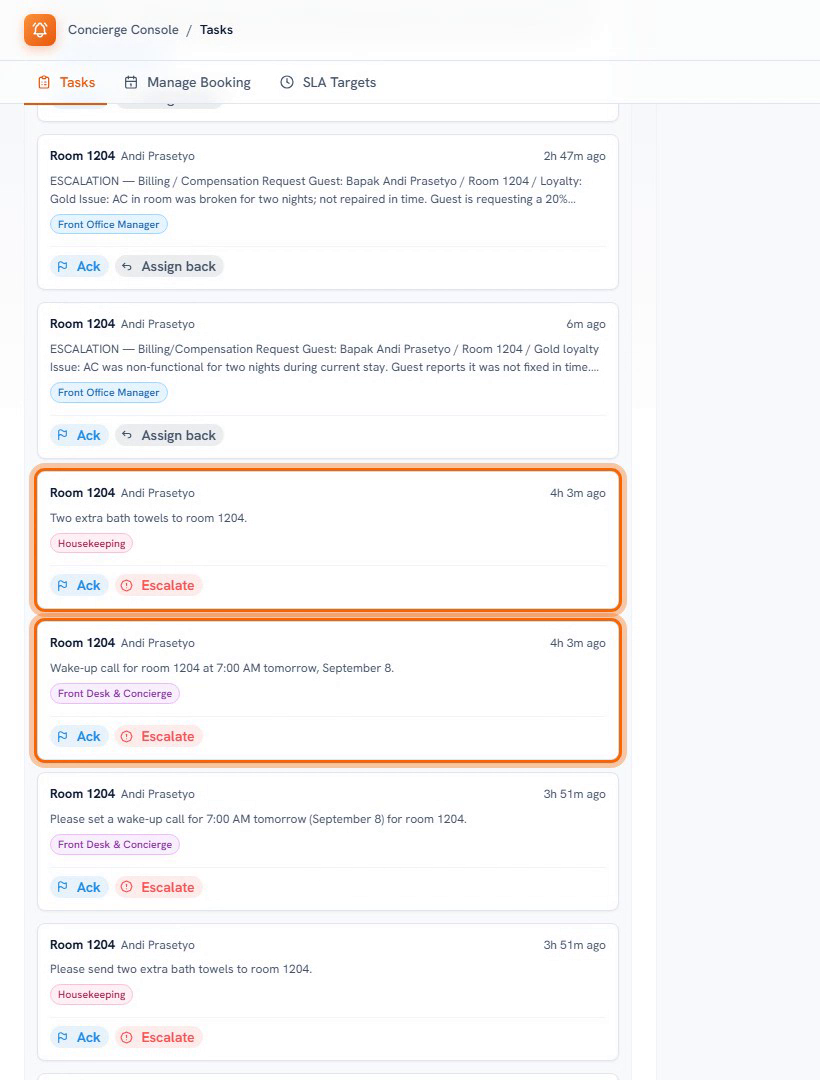
Image: Each request becomes a task with an owning department.
This is where an AI concierge for hotels becomes more than a chatbot.
Hotel teams can see requests on one shared board, including:
Which department owns each task
Which requests are still open
How much time remains
Which tasks are approaching their deadline
So when the shift changes at 22:00, the request does not disappear with the previous team.
The incoming team can see what the hotel has promised and what still needs to be done.
The handover lives in the system, not in someone’s memory.
That means teams can act before the guest has to ask again.
Knowing When AI Should Hand Over to a Person
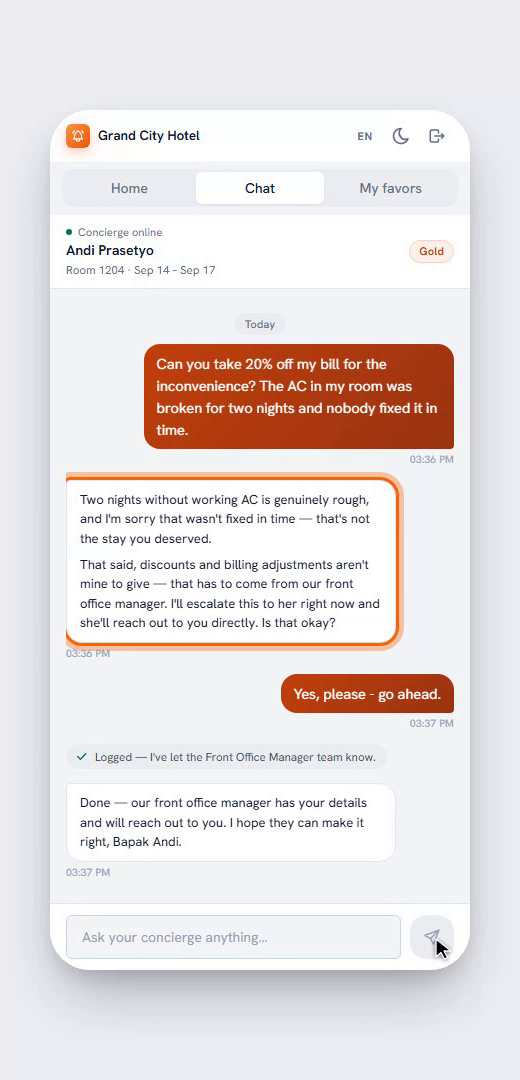
Image: The AI does not give discounts. It passes the request to a manager.
Not every guest request should be handled by AI.
Imagine a guest says:
“The air conditioning has been broken for two nights. I want a discount.”
That requires judgement and authority.
AI Hospitality Concierge does not have to make a decision it is not authorised to make. Instead, it can tell the guest that a manager will follow up and pass the request, along with the relevant context, to the Front Office Manager.
The AI handles the handover.
Your staff remain in control of the decision.
This allows automation to support hotel teams without removing the human judgement that hospitality still depends on.
One View Across Hotel Operations
The value does not stop with frontline teams.
The next morning, the General Manager can open one view and see what is happening across departments, including:
Open requests
Requests at risk of missing their service target
Completed requests
Requests that have been waiting the longest
Instead of piecing together updates from different channels, hotel management has a clearer picture of guest service operations.
That visibility can help teams identify where requests are getting stuck before those operational gaps become guest complaints.
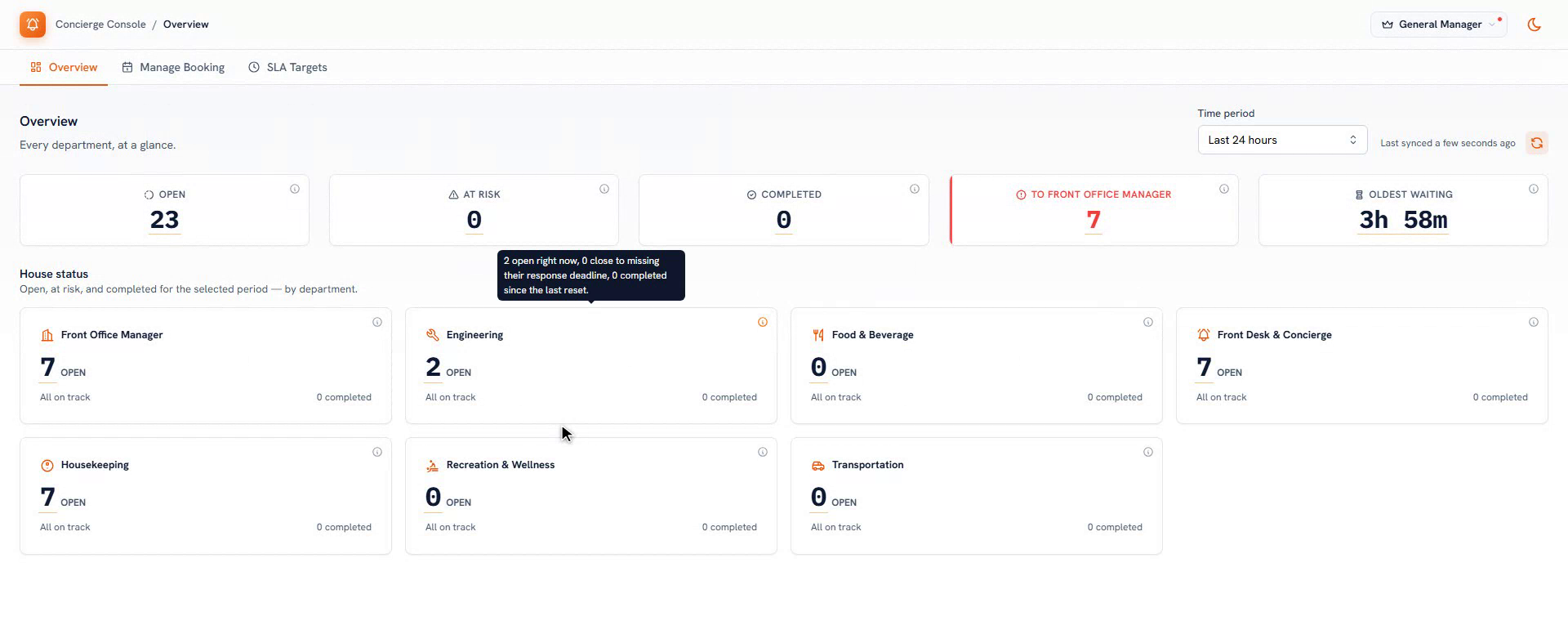
Image: The GM's view: every department on one page.
Built Around How Your Hotel Already Works
AI Hospitality Concierge is designed to fit around hotel operations rather than force every department into a completely new way of working.
Guests interact through chat.
Hotel teams keep their departmental responsibilities and service standards.
The hotel defines the time limits for different types of requests.
Guest information can come from the hotel’s existing systems, with the integration scoped according to each hotel’s environment.
The goal is simple:
Make every guest request visible, actionable and accountable from the moment it is received until it is resolved.
What Happens to the 21:55 Towel Request Now?
Go back to room 1204.
At 21:55, the guest asks for two towels.
The request becomes a Housekeeping task.
At 22:00, the shift changes.
But the task stays visible.
The incoming team can see what the guest requested, who owns it and whether it has been completed.
No handwritten note needs to be rediscovered.
No one has to rely on memory.
And, most importantly, the guest should not have to start the conversation again.
See AI Hospitality Concierge in Action
What would happen to a guest request at your hotel if it arrived five minutes before shift change?
Book a demo of AI Hospitality Concierge and follow a request through an entire hotel journey, from the guest’s first message to departmental follow-up and the General Manager’s view the next morning.
See how your hotel can keep every guest request visible from request to resolution.